The medical device industry is undergoing a significant transformation as manufacturers strive to meet the growing demand for safe, reliable, and high-quality healthcare products. With healthcare systems expanding worldwide and regulatory standards becoming increasingly stringent, manufacturers are expected to deliver precision-engineered medical devices while maintaining consistent quality across millions of units. Products such as disposable syringes, IV cannulas, scalp vein sets, infusion sets, and blood transfusion sets are no longer produced solely through conventional manufacturing methods. Instead, they are increasingly being manufactured using advanced automation technologies that improve efficiency, reduce production variability, and strengthen quality assurance.
Automation has become more than just a production enhancement—it is now a strategic investment that enables medical device manufacturers to remain competitive in an evolving global market. Automated systems minimize human intervention in repetitive manufacturing processes, ensuring greater accuracy, improved traceability, and enhanced process control. As a result, healthcare providers receive products that consistently meet clinical expectations while manufacturers benefit from higher productivity and lower operational risks.
The Growing Need for Automation in Medical Device Manufacturing
Healthcare providers rely on medical devices that perform consistently every time they are used. Even the smallest variation in dimensions, material quality, or assembly can affect clinical outcomes and compromise patient safety. As demand for disposable medical devices continues to rise, manufacturers face the challenge of increasing production capacity without compromising quality or regulatory compliance.
Traditional manufacturing methods, although effective for smaller production volumes, often depend heavily on manual operations. Manual assembly introduces natural variations, increases inspection requirements, and may limit manufacturing speed. In contrast, automated production systems perform repetitive tasks with exceptional precision, enabling manufacturers to produce large volumes while maintaining tight quality tolerances.
Automation also supports manufacturers in complying with internationally recognized quality standards by improving documentation, process validation, and production traceability. Every stage of manufacturing—from raw material handling to final packaging—can be monitored, recorded, and verified through automated systems, creating a more transparent and controlled production environment.
Understanding Automation in Medical Device Manufacturing
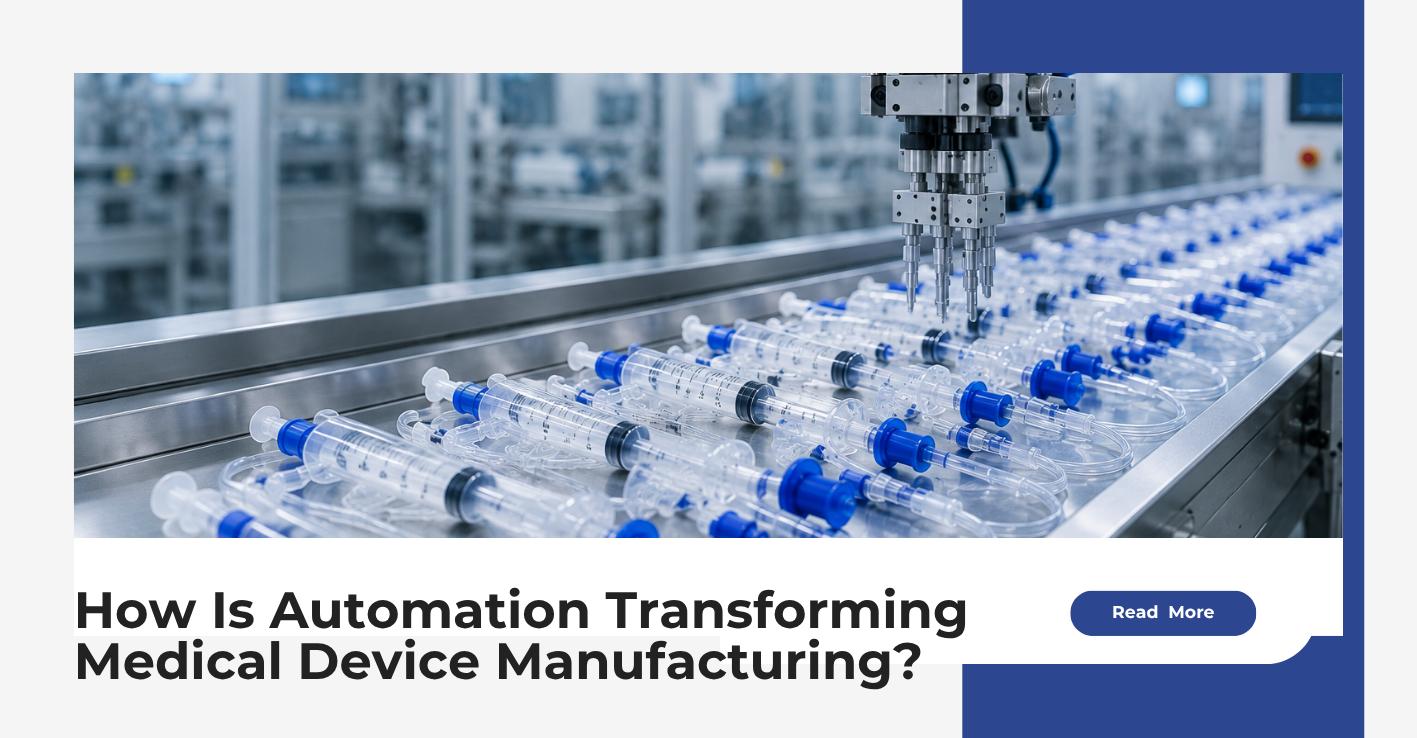
Automation in medical device manufacturing refers to the use of advanced machinery, robotics, computer-controlled production systems, and intelligent inspection technologies to perform manufacturing operations with minimal manual intervention. These technologies work together to create highly efficient production lines capable of manufacturing complex disposable medical devices with remarkable consistency.
Modern manufacturing facilities integrate programmable logic controllers (PLCs), robotic assembly stations, automated material handling systems, and vision inspection equipment to ensure every product meets predefined quality specifications. Rather than replacing skilled professionals, automation enables engineering and quality teams to focus on process optimization, product innovation, and regulatory compliance while repetitive manufacturing tasks are performed with greater speed and precision.
For disposable medical devices, automation plays a critical role in ensuring dimensional accuracy, reducing contamination risks, and maintaining sterility throughout the production process. This level of consistency is particularly important for products that are used directly in patient care, where reliability and performance are essential.
How Automation Enhances Product Quality?
Quality remains the most important factor in medical device manufacturing. Every product must meet strict performance, safety, and regulatory requirements before reaching hospitals, clinics, or diagnostic laboratories. Automation significantly strengthens quality assurance by introducing precision-controlled manufacturing processes that reduce variability and improve consistency across every production batch.
Advanced production equipment performs manufacturing operations according to programmed specifications, eliminating many of the inconsistencies associated with manual assembly. Automated vision inspection systems continuously examine components for defects such as dimensional variations, incomplete assembly, flash formation, discoloration, or surface imperfections. Products that fail to meet quality criteria are automatically rejected before they proceed further along the production line.
Automation also improves quality by enabling continuous process monitoring. Manufacturing parameters such as temperature, pressure, cycle time, and assembly accuracy are measured in real time, allowing production teams to identify deviations before they affect product quality. This proactive approach helps reduce waste, minimize recalls, and ensure that healthcare professionals receive products they can trust.
For manufacturers like ISCON Surgicals, maintaining consistent quality is essential not only for meeting customer expectations but also for supporting hospitals and healthcare providers that depend on reliable disposable medical devices every day.