Choosing the right syringe is easier when you understand the tip design. This guide helps you compare centric, eccentric and catheter-tip syringes, explaining what each type is and what to check before selecting a product for your hospital, clinic or healthcare-supply needs.
The three common configurations are centric tip, eccentric tip and catheter tip syringes. This guide explains the difference between them to help hospitals, distributors and procurement teams compare product specifications accurately.
What is a Centric Tip Syringe?
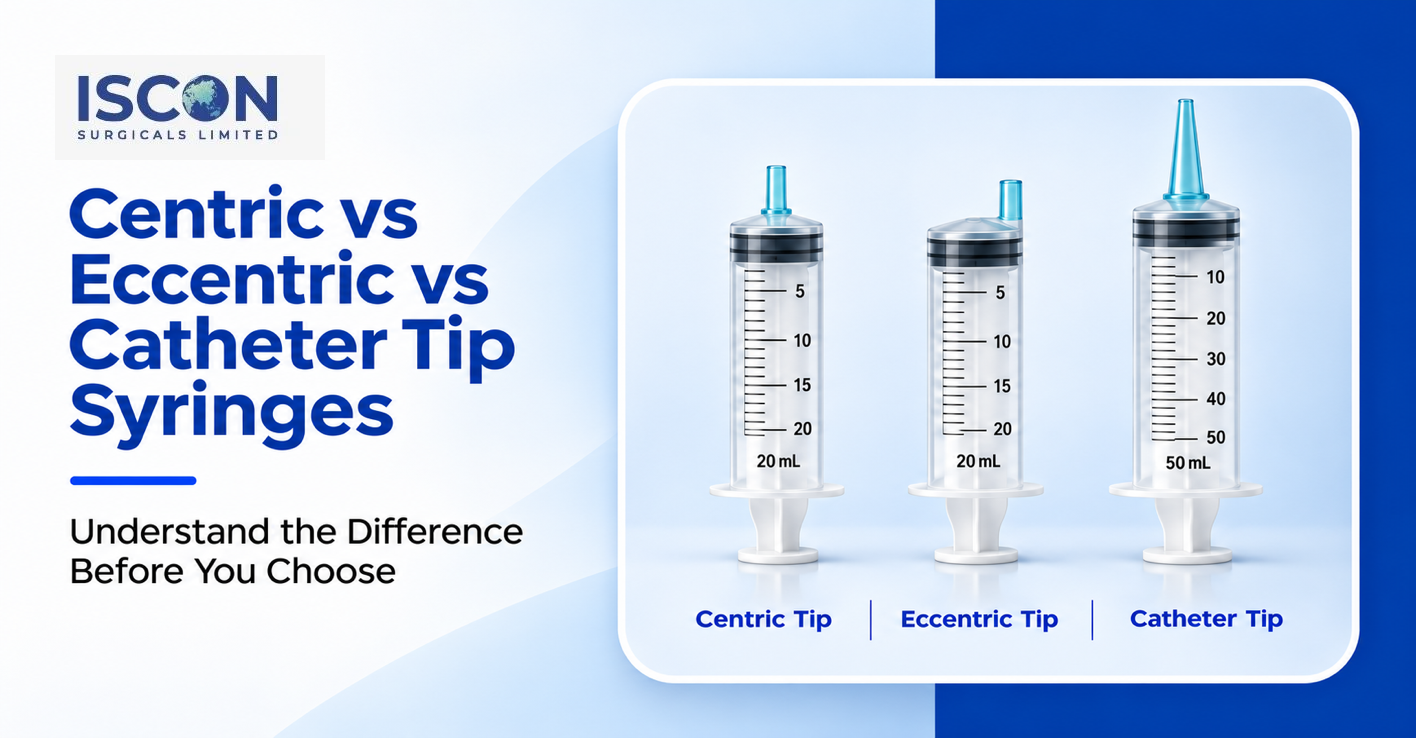
A centric tip syringe has its nozzle positioned in the centre of the syringe barrel.
This is a common configuration for many standard disposable syringes. Centric-tip products may be available in different capacities and with different connection types, including Luer Slip and Luer Lock, depending on the manufacturer’s product range.
Key product features:
- Syringe capacity and graduation markings
- 2-part or 3-part construction
- Luer Slip or Luer Lock connection
- With or without needle
- Sterile packaging format
- Product-specific quality and regulatory documentation
What is an Eccentric Tip Syringe?
An eccentric tip syringe has its nozzle positioned off-centre, closer to the side of the barrel. Regulatory filings for disposable syringes describe eccentric Luer Slip connectors as off-centred, push-on designs.
Because the nozzle sits near the edge of the barrel, the tip can be held closer to the surface. This can be useful where a shallower angle is needed. Eccentric tips are often found on larger syringe capacities.
The term “eccentric” describes the placement of the tip, not the syringe capacity or needle gauge. Buyers should verify the exact nozzle type and available volumes in the manufacturer’s catalogue.
Key product features:
- Whether the tip is eccentric Luer Slip or another configuration
- Available syringe volumes
- Compatibility with the intended needles and accessories
- Sterile, single-use packaging
- Product instructions for use
What is a Catheter Tip Syringe?
A catheter tip syringe has a longer, tapered nozzle designed to connect with compatible tubing or catheters. It is not a Luer connection and will not fit standard Luer needles or connectors.
Catheter-tip syringes are commonly available in larger capacities. Depending on the product’s labelled intended use, they are typically used with compatible tubing for irrigation, aspiration and enteral or feeding-tube applications.
For enteral applications, many healthcare systems are moving to ENFit connectors (ISO 80369-3), which are designed to reduce the risk of misconnection between enteral and other medical lines. Buyers should confirm whether their facility requires ENFit-compatible syringes instead of open catheter tips.
Key product features:
- Tip diameter and taper
- Syringe capacity
- Compatibility with the intended tubing or catheter
- ENFit or catheter-tip requirement for enteral use
- Clear graduation markings
- Single-use sterile packaging
- Instructions for use and storage requirements
Centric vs Eccentric vs Catheter tip: Quick Comparison
| Type | What it is | Typical buyer need |
|---|---|---|
|
Luer slip |
Needle pushes onto a tapered tip |
General injections; lowest cost |
|
Luer lock |
Needle twists and locks onto a threaded tip |
Secure connection for infusion lines and viscous drugs |
|
2-part |
Barrel and plunger only, no rubber gasket |
Latex-free and silicone-oil-free requirements |
|
3-part |
Barrel, plunger and rubber gasket |
Smooth plunger movement and accurate dosing |
|
With needle / without needle |
Needle pre-attached, packed alongside, or excluded |
Smooth plunger movement and accurate dosing |
|
Auto-disable (AD) |
Locks after one use so it cannot be refilled |
Immunisation programmes and government tenders |
|
Insulin |
Fine fixed needle, marked in units (U-40 or U-100) |
Diabetes care; pharmacies and hospitals |
Luer Lock and Luer Slip are not the same as tip position
It is important not to confuse the tip position with the connection type.
- Centric and eccentric describe where the nozzle is placed on the barrel.
- Luer Slip and Luer Lock describe how compatible needles and accessories attach to the syringe.
- Catheter tip describes a longer, tapered, non-Luer nozzle configuration.
Luer Slip and Luer Lock connectors for intravascular and hypodermic applications are covered by ISO 80369-7.
How to choose the correct syringe-tip configuration?
Do not select a syringe by tip appearance alone. Always check the product code, label, instructions for use and compatibility information.
- The required syringe volume
- The intended application stated in the product documentation
- Centric, eccentric or catheter-tip configuration
- Luer Slip, Luer Lock, catheter tip or ENFit connection
- Compatibility with needles, tubing, catheters or connectors
- Sterility and packaging requirements
- Applicable quality standards and regulatory documentation
Frequently Asked Questions (FAQs)
A centric syringe has the nozzle in the centre of the barrel. An eccentric syringe has the nozzle positioned off-centre, closer to the side of the barrel, which lets the tip sit closer to the surface.
Not always. “Eccentric” refers to nozzle placement, while “Luer Slip” refers to a push-on connection type. Most eccentric syringes use a Luer Slip connection, so a product specification often includes both.
Catheter-tip syringes are typically used with compatible tubing for irrigation, aspiration and enteral or feeding-tube applications, as stated in the product’s labelled intended use. They do not fit standard Luer needles.
The right tip depends on the required volume, connector compatibility, intended application and product instructions. Contact the manufacturer to confirm the correct product specification before ordering.
Conclusion
ISCON Surgicals supplies disposable syringes in multiple sizes and tip configurations, including centric and eccentric Luer tips and catheter-tip options. Contact our team for product specifications, packaging details and bulk-order enquiries.